Platform Modernization: Legacy to AWS and Guidewire Architecture

1. The 5-Layer Target Architecture Blueprint
A successful Guidewire cloud deployment must strictly enforce clear boundaries between transactional processing, integration routing, and digital presentation. We structure the estate into 5 distinct architectural layers: • Layer 1: Core Guidewire Suite: PolicyCenter for underwriting, ClaimCenter for loss management, and BillingCenter for receivables running in secure private subnets. • Layer 2: API Gateway & Integration Fabric: AWS API Gateway paired with Apache Kafka / AWS EventBridge for real-time asynchronous event streaming. • Layer 3: Omnichannel Experience Layer: Modern Next.js portals and mobile apps providing frictionless quoting and claim filing for brokers and policyholders. • Layer 4: Cloud Data Platform: Change Data Capture (CDC) streaming core records into Snowflake / AWS Redshift for real-time actuarial analytics. • Layer 5: Enterprise Governance & Security: Multi-account AWS Organizations, AWS IAM least-privilege policies, AWS WAF, and automated CloudWatch observability.
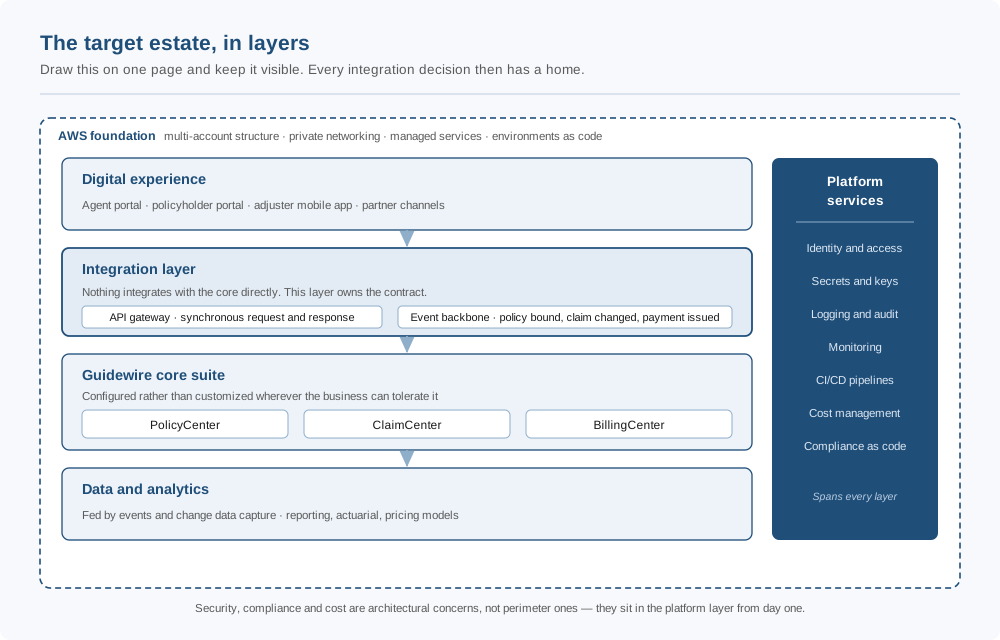
The 5-layer target architecture on one page. Platform security and observability span every tier rather than sitting beside them.
2. The Configuration vs. Customization Trap (The 80/20 Golden Rule)
The number one cause of budget overruns in insurance modernization is over-customization. Guidewire provides an extensive product model and business rule engine out of the box. Yet, many organizations fall into the trap of writing hundreds of thousands of lines of custom Gosu code to replicate legacy quirks that no longer add value. • The 80/20 Rule: 80% of insurance workflows (address validation, payment receipts, standard claim lifecycles) should utilize Guidewire's standard base configurations. • Customization Isolation: Custom business differentiators (specialized actuarial risk algorithms, proprietary partner integrations) must be built as external microservices communicating via REST APIs, keeping the Guidewire core clean and upgradeable in weeks rather than months.
3. Designing the AWS Foundation: Multi-Account VPCs & High Availability
Before installing a single Guidewire component, the AWS landing zone must be established with financial-grade resilience: • Multi-Account Structure: Separate AWS accounts for Core Production, Staging, QA Testing, Shared Services, and Security Auditing connected via AWS Transit Gateway. • Database Resilience: Amazon Aurora PostgreSQL Multi-AZ with automated storage auto-scaling, cross-region read replicas, and PgBouncer connection pooling to handle morning transaction surges. • Zero-Trust Private Networking: Guidewire application clusters reside exclusively in private subnets with no direct internet access. All outbound communication to payment gateways or bureaus passes through NAT Gateways and AWS Network Firewalls.
4. Real-Time Integration & Event-Driven Routing
In a modern carrier ecosystem, Guidewire must communicate seamlessly with dozens of external systems: credit rating bureaus, catastrophe modeling engines, DMV driving record databases, and payment processors. • Synchronous Interactions: Fast, transactional lookups (e.g., instant credit score checks or vehicle VIN decoders) utilize AWS API Gateway with mTLS authentication and aggressive Redis caching. • Asynchronous Event Backbone: Mission-critical business milestones (e.g., 'Claim Filed', 'Policy Bound', 'Payment Overdue') emit JSON events to an AWS EventBridge / Kafka bus. Downstream services—such as automated fraud detection algorithms and customer notification bots—consume these events independently without blocking the core claims adjuster UI.
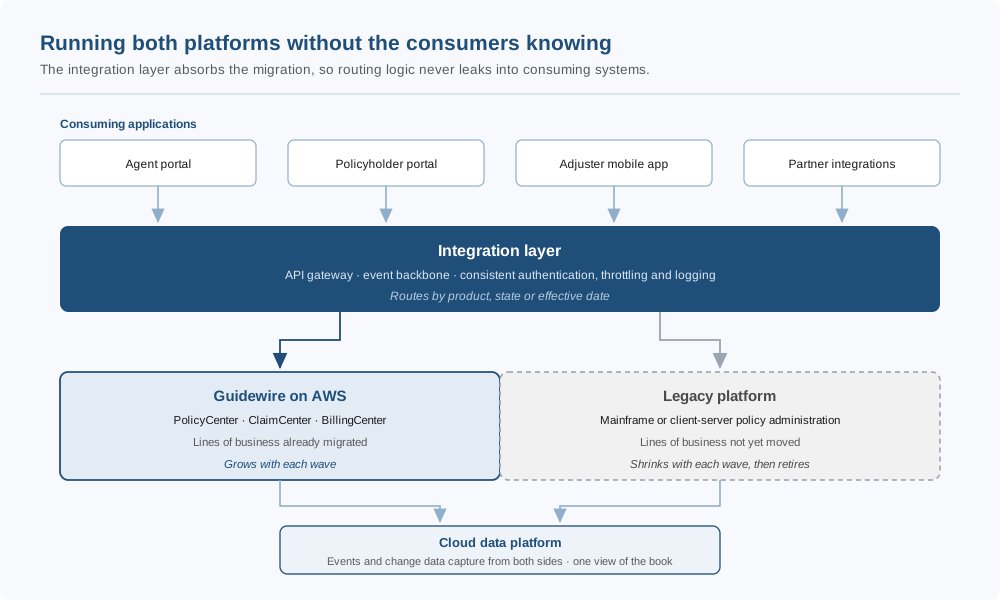
During migration, both platforms run concurrently. The API routing layer directs traffic intelligently by line of business and jurisdiction.
5. Catastrophe (CAT) & Surge Scaling Architecture
During major natural disaster events (hurricanes, hailstorms, wildfires), insurance claim intake volume can spike by 2,000% within hours. A legacy system will collapse under this load, stranding policyholders. Our AWS Guidewire blueprint incorporates elastic surge protections: • Digital First Notice of Loss (FNOL) Ingress: Policyholders upload damage photos and file initial claims through lightweight Next.js serverless web apps hosted on AWS CloudFront. • Asynchronous SQS Claim Queues: First Notice of Loss submissions are queued in Amazon SQS FIFO queues, decoupling front-end mobile traffic from Guidewire ClaimCenter database writes. • Auto-Scaling Compute Workers: Fargate microservices scale horizontally to parse claims, calculate preliminary damage reserves, and push records into ClaimCenter at an optimal, non-blocking ingestion rate.
6. The Data Migration Strategy: Transforming Decades of Legacy Records
Data migration is where most insurance programs struggle. Legacy databases often contain inconsistent policy dates, orphaned claim notes, and incompatible coverage codes. Our proven migration strategy follows four rigorous stages: 1. Staging Landing Zone: Extract legacy DB2/Oracle tables into an AWS S3 data lake in raw Parquet format. 2. Automated Data Cleansing: AWS Glue ETL jobs normalize addresses, validate tax IDs, and map historical coverage codes to Guidewire data models. 3. Dry-Run Migration Waves: Execute iterative mock migrations in pre-production, validating data integrity down to actuarial reserve balances. 4. Cold Storage Archival: Policies and claims closed more than 7 years ago are converted to searchable read-only PDFs and stored in AWS S3 Glacier Deep Archive, saving over 80% in high-tier database storage costs.
7. Security, Compliance & Cloud Cost Governance
Operating financial platforms in the cloud requires defense-in-depth security controls: • Encryption Everywhere: All data at rest is encrypted using AWS KMS with Customer Managed Keys (CMK) and automated annual key rotation. All traffic in transit is enforced with TLS 1.3. • AWS WAF Defense: Edge rulesets actively block SQL injection attempts, cross-site scripting (XSS), and rate-limit bot scanners. • Automated Cloud Cost Control: Non-production development and testing environments are automatically shut down outside business hours via AWS Lambda schedules, reducing monthly cloud infrastructure expenditures by up to 35%.
8. The 24-Month Roadmap: Wave-by-Wave Execution
Pacing is the secret to enterprise transformation success. We recommend a phased 4-wave rollout over 18 to 24 months: • Wave 1 (Months 1–4): AWS Landing Zone setup, security framework, and API integration layer. • Wave 2 (Months 5–10): ClaimCenter pilot launch in a single geographical state / product line. • Wave 3 (Months 11–18): PolicyCenter & BillingCenter rollout for primary commercial and personal lines. • Wave 4 (Months 19–24): Final legacy data archival, decommissioning of legacy mainframes, and full cloud optimization.
Did you find this technical deep dive insightful? Leave a like!
Strategic Takeaway
Carriers that resist excessive custom code, prioritize data decoupling, and embrace a phased wave rollout achieve cloud transformation in record time. Guidewire on AWS provides the ultimate foundation for scalable, automated, and intelligent modern insurance operations.
Discussion & Engineering Insights
Join the conversation with enterprise architects and peer engineers