Legacy Modernization to Cloud Framework: A Pragmatic Blueprint for Enterprise Transformation

1. Why Legacy Systems Hold On for Decades (The Friction Forces)
Before attempting to modernize any legacy estate, architects must deeply understand why these systems survived for so long in the first place. In enterprise insurance and banking, three structural forces resist change: • Regulatory & Audit Lock-in: Statutory retention mandates require carriers to preserve 10 to 30 years of transactional policy and claim histories with immutable precision. Any data mismatch during migration risks severe regulatory fines. • Embedded Business Logic: Decades of edge-case underwriting rules, custom state filing exceptions, and proprietary actuarial algorithms are baked directly into database stored procedures and batch scripts, often with zero living documentation. • Extreme Risk Asymmetry: The reward for a successful rewrite is incremental operational efficiency; the penalty for a failed cutover is front-page reputational damage, policyholder attrition, and millions in downtime losses. Any modernization framework that fails to account for these forces is doomed from day one. You cannot treat a core enterprise engine like a greenfield startup prototype.
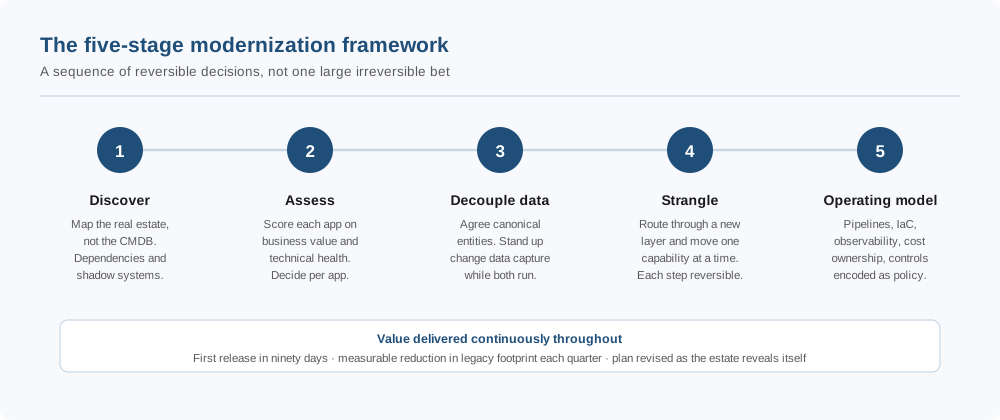
The five stages in sequence. Each phase is incremental, modular, and small enough to reverse if issues arise.
2. The Pitfall of the 'Big Bang' Rewrite (Why 70% of Enterprise Programs Fail)
The most dangerous trap in enterprise IT is the multi-year 'Big Bang' rewrite: an executive commitment to spend 3 to 4 years secretly building a brand new system, followed by a dramatic weekend cutover. In practice, this strategy almost always fails catastrophically. While the new system is being coded, the existing business does not freeze—new regulatory mandates, products, and partner integrations continue to be added to the legacy system. By the time the replacement is ready for testing, it is already obsolete. Instead, progressive modernization uses the 'Strangler Fig' pattern. We place an intelligent API and event routing layer in front of the legacy core, routing modern digital transactions to new cloud microservices while leaving the core mainframe untouched until each domain is completely proven.
3. Phase 1: Automated Discovery & Technical Debt Inventory
You cannot modernize what you do not understand. Phase 1 begins with automated codebase and data profiling: • Automated Dependency Mapping: Code scanners parse legacy repositories to map application entry points, dead code paths, and circular dependencies. • Data Lineage & Flow Analysis: Documenting how data flows from the core database out to third-party rating bureaus, state compliance engines, and downstream billing feeds. • Exposing the 'Shadow IT' Layer: In nearly every enterprise healthcare or insurance estate, you will uncover a shadow layer of Microsoft Access databases, local VBA macros, and manual Excel spreadsheets performing mission-critical underwriting calculations. Modernization must catalog and incorporate these shadow workflows into the target architecture.
4. Phase 2: The 2x2 Application Assessment Matrix (The Discipline of Doing Nothing)
Not every application in your enterprise portfolio deserves to be rebuilt. A mature architecture team evaluates every system on two axes: Business Value vs. Technical Health: 1. Rebuild / Refactor (High Business Value, Poor Technical Health): Core policy engines and customer mobile portals that drive revenue must be modernized first. 2. Replatform / Lift & Reshape (High Business Value, Healthy Architecture): Monolithic APIs can be containerized into Docker and moved to AWS ECS Fargate with minimal code modifications. 3. Retain / Leave Alone (Low Business Value, Healthy): Internal administrative batch jobs that run quietly once a month should not consume modernization budget. 4. Retire / Decommission (Low Business Value, Poor Health): Redundant reporting tools and legacy third-party plug-ins that can be replaced with standard SaaS offerings.
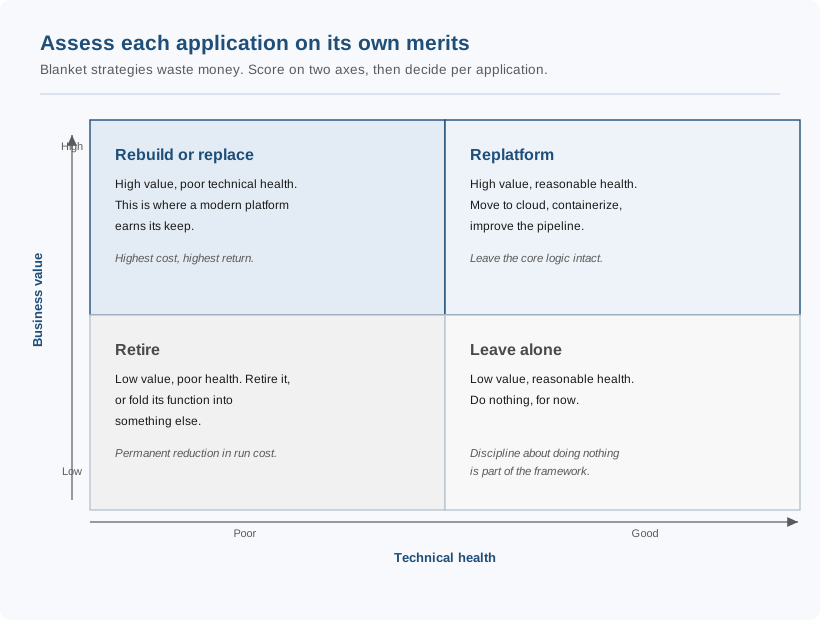
Two axes, four distinct decisions. The discipline to leave healthy, low-value systems alone preserves engineering resources.
5. Phase 3: Decouple the Data Layer Before Touching Applications
The single biggest architectural failure in cloud migrations is trying to move application logic before solving data synchronization. Legacy systems store data in tightly coupled, denormalized formats. If you move an application to the cloud while leaving its data locked on a slow mainframe via VPN calls, network latency will cripple performance. To decouple data cleanly: • Implement Change Data Capture (CDC): Tools like Debezium or AWS Database Migration Service (DMS) tail the legacy database transaction log (DB2/Oracle) and stream row-level mutations into Apache Kafka topics in sub-second time without placing read locks on the production mainframe. • Establish Canonical Data Models: Transform legacy record layouts into standard JSON schemas (e.g., ClaimEvent, PolicyIssued, MemberEnrolled). • Sync to Cloud Read Replicas: Cloud microservices query high-speed PostgreSQL and DynamoDB read stores locally without issuing a single query to the mainframe.
6. Phase 4: Event-Driven API Facades & Dual-Run Validation
With data streaming in real-time, we stand up an API Gateway facade. All web traffic, mobile apps, and third-party partner portals now speak to the API Gateway. During the Dual-Run phase: 1. Incoming requests (e.g., a claim submission) are processed by the new cloud microservice. 2. In parallel, a 'shadow transaction' is sent to the legacy mainframe. 3. Automated reconciliation bots compare the results of both engines down to the penny. 4. Once reconciliation matches 100% across 50,000 live production transactions, the legacy execution path is permanently switched off.
7. Handling Distributed Transactions: The Outbox & Saga Patterns
During a phased migration, some business workflows will span both the new cloud services and the remaining legacy core. To prevent data corruption without relying on fragile two-phase commit (2PC) protocols, implement the Transactional Outbox Pattern: • When a cloud service commits a state change (e.g., 'Policy Approved'), it writes both the domain record and an Outbox message in the same local database transaction. • An asynchronous publisher relays the outbox event to Kafka, which invokes a Saga Orchestrator to update downstream legacy billing engines. If an error occurs, automated compensating transactions reverse the state safely.
8. Executive Summary & The 90-Day Quick-Win Rule
Legacy modernization is not an IT project—it is an organizational evolution. To maintain executive momentum and board funding, teams must establish a strict '90-Day Quick Win Rule': deliver one customer-facing capability (such as digital claim document uploads or real-time SMS status tracking) within the first 3 months. Proving tangible ROI early builds stakeholder trust for the larger core transformation.
Did you find this technical deep dive insightful? Leave a like!
Strategic Takeaway
Carriers and enterprises that modernize through incremental domain extraction, event-driven data decoupling, and dual-run validation consistently cut delivery timelines in half while reducing operational risk to near zero. Build the data fabric first, strangle the monolith domain by domain, and let business value dictate every technical choice.
Discussion & Engineering Insights
Join the conversation with enterprise architects and peer engineers